
4.4 billion-year-old mineral found in Australia reveals new clues about Earth’s formation |
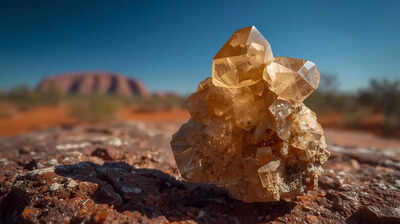
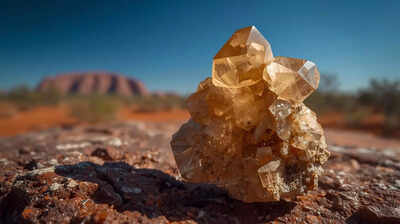
Old crystals found in Western Australia are drawing fresh attention from geologists studying how the planet first took shape. These minerals, known as zircons, were recovered from ancient rocks in the Jack Hills region and are dated to be more than four billion years old. They are widely regarded as the oldest known minerals on Earth. Because almost no rocks from that early period have survived, researchers rely on these tiny crystals to piece together what conditions were like during Earth’s formation. Recent chemical analysis suggests the story may be more complex than once thought. The findings add new detail to debates about when continents began forming and whether plate tectonics was already active on the young planet. The research also refines timelines used in broader Earth formation models.
Jack Hills’ zircons are the oldest known minerals on Earth
According to the study “Contemporaneous mobile- and stagnant-lid tectonics on the Hadean Earth”, the Jack Hills area in Western Australia has produced zircon crystals dated to about 4.4 billion years old. Earth itself formed roughly 4.5 billion years ago, so these grains come from a very early chapter. Most rocks from that time were destroyed by heat and pressure deep underground. Zircons survive because they are chemically stable and physically tough.Each crystal is small, often no wider than a grain of sand. Inside, however, they preserve chemical traces from the magma in which they formed. Scientists use uranium-lead dating to determine their age. That method is well established and has been tested across many rock types.
Chemical signatures suggest early crust formation
Recent studies have focused on trace elements inside the Australian zircons. Ratios of hafnium isotopes, along with oxygen measurements, indicate that some of the magma involved interaction with water and older crustal material. That detail matters.If water was present in significant amounts, it suggests parts of the early Earth were cooler than once assumed. Some researchers interpret the data as evidence that continental crust began forming earlier than previously believed. The crystals do not show the full picture, but they hint at recycling of surface material within a few hundred million years of Earth’s birth.The idea contrasts with older models that described the young planet as largely molten for an extended period.
Evidence points to possible early tectonic activity
A number of the Jack Hills zircons contain chemical patterns seen today in regions where tectonic plates interact. In modern settings, subduction zones produce certain magma types that leave recognisable element signatures. Similar signals appear in some of these ancient grains.This does not prove that modern style plate tectonics operated exactly as it does now. Conditions on early Earth were likely different, with higher internal heat. Still, the data has led some scientists to argue that limited tectonic processes may have begun very early.Other ancient zircons from different regions show alternative patterns linked to volcanic plumes. That variation suggests the early crust may not have behaved in a single uniform way. The debate continues quietly in research journals. For now, these small Australian minerals remain central to discussions about Earth formation, offering fragments rather than full answers.