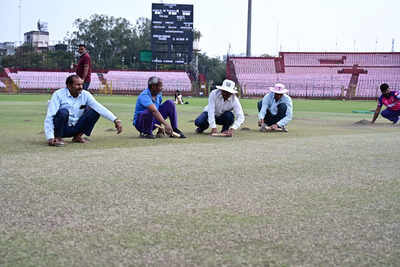

Shane Bond exclusive: ‘How you manage tearaway quick bowlers is really important’ | ILT20 | Cricket News


TimesofIndia.com in Dubai: Former New Zealand speedster and Gulf Giants bowling coach Shane Bond reflects on ILT20’s growth, its unique blend of global and local talent, and the challenges of coaching in a multicultural environment. In a free-wheeling chat with the TimesofIndia.com Bond opens up about fast-bowling workloads, modern leagues, injury management, and why grounding in first-class cricket still matters.Excerpts from the interview…You have been part of so many franchises and have been a globe-trotter as a coach. How do you see the ILT20 growing?It’s great, mate. I mean, I did the first season here, so it’s nice to come back to it. I think it’s a unique league because you have so many different overseas players from different countries, and obviously you’ve got the local players. That’s the part that I really enjoy — just seeing the local players get the opportunity to play in the league. So I think it’s the responsibility of cricket communities to bring a whole lot of different countries up, and this is a league that’s definitely helping those UAE players.For me as a coach, it’s also a little bit more challenging because you’re dealing with things like language, culture, trying to bring people together. And so it gets you to think about your own coaching and how you go about it. I mean, it’s invigorating.
ILT20 has its first player auction this year. How much do you think a fiery Shane Bond could have bagged?Mind you, I played the IPL for a year (laughs).So I got the whole auction experience, which was really exciting. And then after that, I remember sitting in rooms with Corey Anderson and Trent Boult when they went for really good money, and that was really exciting as well. So I think every time there’s an IPL auction, someone does extremely well out of it. There’s been a whole heap of Kiwis that I’ve known who have done that. You get super excited for them.I don’t look back and go, what if, or whatever. That’s not my time now. It’s just the way it goes. I’m just lucky that I get the chance to work alongside the players. I’m still involved in cricket — in a job in cricket. I’m very lucky to have that.So every time that auction comes up, I think everyone’s always wanting to know who’s going to go for the big money, who’s going to go where. And as I said, there are not too many bad people in cricket. So the people who do get a big payday and have a life-changing experience — it’s pretty cool to see that.Your career was ravaged by injuries. As a fast-bowling coach, what’s your advice to tearaway fast bowlers like Mayank Yadav and Umran Malik, who are battling injuries every now and then?The biggest thing you’ve got to remember when you’re going through 18 to 24 is that your body’s still growing. Your bones are still growing — all that sort of stuff. So what’s the tendency? If you get someone who’s exciting and bowls fast, you just want to play them all the time. And the reality is, if you do that, they’re going to break.So management and how you manage those bowlers is really important. And I think that’s the thing — going, okay, are we prepared to rest this player, give them some time to condition, and actually not play them in every game? Because they’re going to break.And I think you look at a guy like Pat Cummins — he missed five years. When they brought him back, they brought him back through one-day cricket. He’d grown bigger, stronger. They eased him back in. And then he’s had this incredible career that people sort of forget included those five years he missed.So I think it’s a combination. Some people have more durability than others — that’s just natural. I think sometimes the management has just got to get a little bit better. When players get fit, there’s one thing — being fit for cricket — but sometimes players, especially good players, get fit and you just throw them straight back into top-level cricket. You don’t give them the chance to ease through club cricket or second-level cricket — just to get some time and overs under the body and create a bit more durability. There’s a tendency to rush those players back, and as soon as you rush someone back and the intensity goes up, the risk of injury goes up.
Poll
Do you think the rise of T20 leagues has complicated the careers of fast bowlers?
Has cricket become more difficult for fast bowlers with three formats and multiple leagues?It depends on what format you’re playing. I think that’s one of the challenges if you’re playing all formats. It’s obviously become more lucrative. I think it’s been more of a challenge maybe for the smaller countries. If you look at Australia, India, and England, they pay a lot of money. Their fast bowlers tend to stay. The classic examples are Mitchell Starc, Josh Hazlewood, and Pat Cummins — they’ve played for Australia for a long time.For Kiwis, you look at Lockie Ferguson, Adam Milne to some degree. Because you’re not getting paid at the same level, you now have the opportunity to step away from your national team. New Zealand have had to juggle that, and I think they’ve juggled it pretty well.If you’re given the opportunity to make ten times as much money to bowl a quarter of the overs, it’s hard not to take that up — particularly with the injury risk that Test cricket presents. The more overs you bowl, the more chance you have of getting hurt. I think it’s just a different time. T20 leagues have taken over, and you can’t blame people for wanting to maximise their earning potential. And to be fair, when you jump around the world — going to South Africa, Dubai, Australia, doing all this stuff — it’s pretty cool. It’s good fun. You can’t blame people for doing that.Are you someone who tells young fast bowlers to play more first-class cricket to improve?I tell them it’s their decision. I can advise, but it’s not my choice. My job is to support. I think there’s something to be said about a grounding in first-class cricket. Obviously, the more you bowl — if you can stay fit — with proper management, you learn to groove your technique and understand your technique. I think that’s no different to a batter. You understand how to bat, how to bat time, what works, what doesn’t. If you’re playing the longer form of cricket, it can help that.I think you’ve seen players step away from long-form cricket and then sometimes step back because they realise they just need that time. You definitely need that grounding in longer-form cricket. Even in short-form cricket, the ability to put the ball on the spot, hit the top of the stumps consistently — it translates across formats. Then all the variations feed off that.I think you’ve seen that in the IPL a little bit. You’ve got these young guys who’ve come on the scene — they bowl quick, but without control, it doesn’t matter. Whereas the Hazlewoods of the world have come in, hit the top of off stump, worked on their variations, and are now awesome T20 bowlers. There’s something to be said about understanding how to hit the top of off stump consistently all day.If a 20-year-old quick aims to play 12–13 years at the top, how can he manage his workload today?He’ll play for four or five different teams with coaches who all have different expectations. I think the biggest thing as a coach is to ask: what is in the best interest of this player? It’s not about me winning the title — it’s about how I look after this player and get him to where I think he can go.You sit down with that player and go, this is what I think is best for you. How do we get you here fully fit? If I do that, and he stays on the park longer, he’ll have a long, successful career — and as a coach, I’ll probably get the benefit of that too.Look, it’s challenging. Every player is different; they go through different experiences. But one thing I think is that as a coach, you have a duty of care to look after a player and do whatever you can to help them stay on the field.