
‘Mini-sonic booms’ on Mars: Nasa rover records electric sparks in dust devils — watch
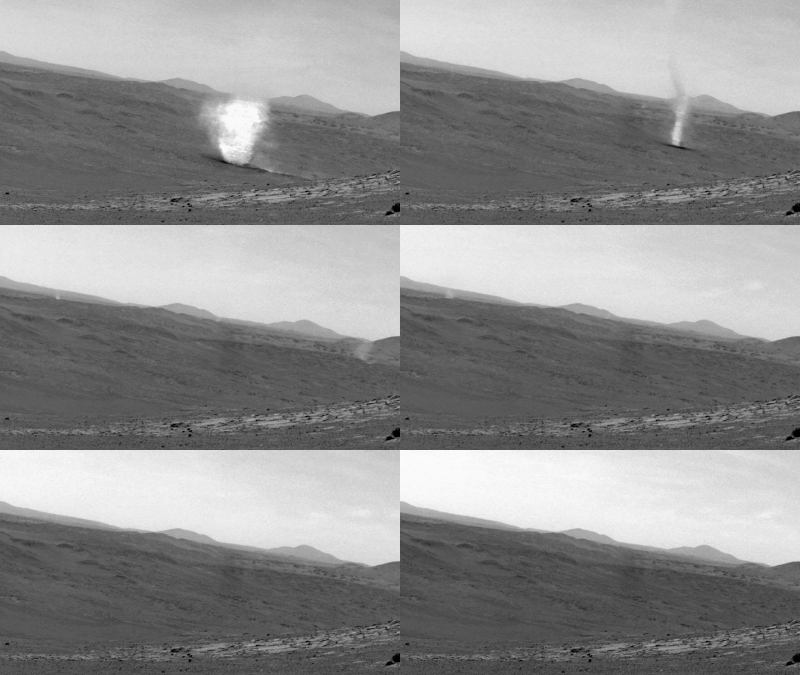
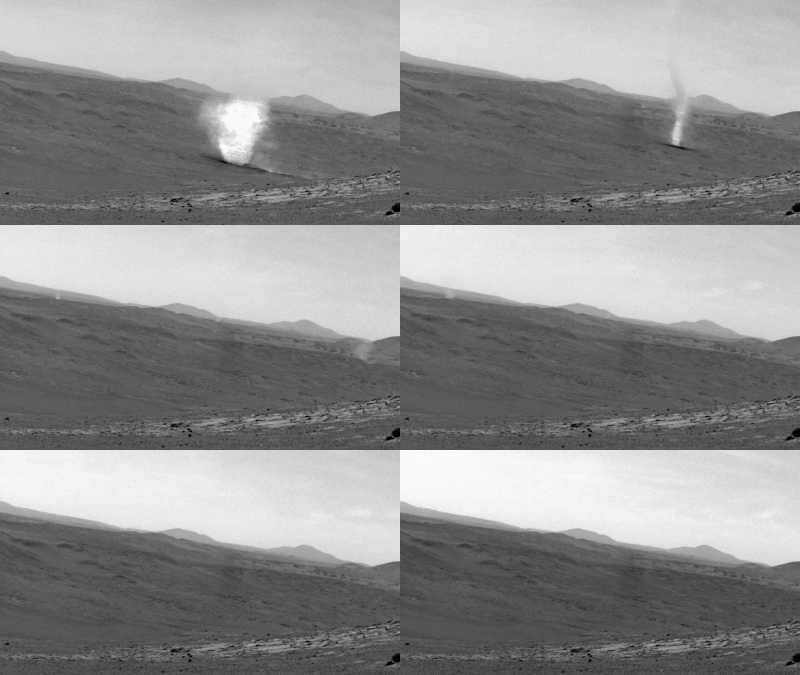
Nasa’s Perseverance rover has confirmed a decades-old scientific hunch: tiny electric discharges, essentially miniature sparks, crackle inside Martian dust devils and during regional dust storms. The findings, published in Nature and detailed in Nasa’s article “Nasa Rover Detects Electric Sparks in Mars Dust Devils, Storms”, could reshape understanding of the Red Planet’s atmospheric chemistry, climate and potential habitability and potentially also influence the design of future robotic and human missions, the article stated.The discovery is based on audio and electromagnetic data collected by Perseverance’s SuperCam microphone, which has detected 55 distinct electrical events since 2021. Sixteen of these occurred when dust devils passed directly over the rover. According to coauthor Ralph Lorenz, a Perseverance scientist at the Johns Hopkins Applied Physics Lab in Laurel, Maryland, the recordings captured unmistakable acoustic signatures. “We got some good ones where you can clearly hear the ‘snap’ sound of the spark,” he said. “In the Sol 215 dust devil recording, you can hear not only the electrical sound, but also the wall of the dust devil moving over the rover. And in the Sol 1,296 dust devil, you hear all that plus some of the particles impacting the microphone.”Dust devils, spinning columns of rising warm air that lift fine dust, are common on Mars. Scientists had long suspected that friction between tiny grains could create triboelectric charging, similar to the static shock you feel after walking across a carpet. As The New York Times reported, lead researcher Dr Baptiste Chide described the centimetre-scale sparks as “mini-lightning”. One event was recorded roughly six feet from the rover and several smaller discharges occurred within inches of the microphone. “What we are seeing are tiny sparks, but on Mars, even tiny sparks can tell us a lot about the atmosphere,” he said.Recordings from Sol 215 and Sol 1,296 captured sharp “snap” sounds from discharging particles, along with dust impacts on the microphone. Another 35 electrical events were linked to turbulent convective fronts during dust storms. Researchers found that discharges did not increase during Mars’ dustiest seasons. This suggests that turbulence and local lifting of particles, rather than the total amount of airborne dust, drives electrical activity.The implications are significant. Even small sparks can trigger chemical reactions that form highly oxidising compounds such as chlorates and perchlorates. These substances can destroy organic molecules on the surface and may help explain the rapid disappearance of methane in the Martian atmosphere. Electrostatic forces may also influence dust movement, an important yet poorly understood factor in Mars’ climate.A Nature commentary urged scientific caution. Particle physicist Dr Daniel Pritchard wrote that although the recordings provide persuasive evidence of dust-induced discharges, the lack of visual confirmation means some doubt will remain over whether this was truly Martian lightning.Although the sparks are too small to endanger astronauts directly, experts note that repeated discharges could interfere with electronics or gradually degrade spacesuits. Reuters reported that researchers hope future Mars missions will carry more sensitive cameras and dedicated instruments to confirm and study these micro-sparks.