

3I/ATLAS is carrying ‘key’ ingredients for life, NASA scientist finds |
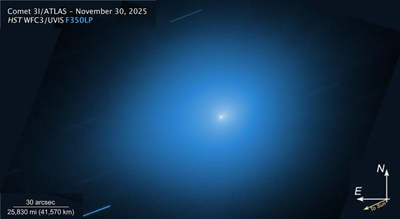
Ever since 3I/ATLAS was first spotted in July, it’s been the space object everyone argues about. It’s only the third interstellar visitor ever found passing through our Solar System, and it has refused to sit neatly in the “just another comet” box. Its strange colour shifts, abrupt changes in speed, and the appearance of both a tail and an anti-tail have kept astronomers on alert for months. And, more recently, the comet has added yet another oddity to the list: a now-famous 16.16-hour “heartbeat,” a rhythmic brightening and dimming that scientists are still trying to explain.NASA’s line has stayed consistent: 3I/ATLAS is a comet, it poses no threat to Earth, and it will stay far away. Harvard astrophysicist Avi Loeb, meanwhile, has spent months saying we shouldn’t rush to that conclusion. He’s suggested there is a 30–40% chance the object is not naturally formed, has talked about features that “could be related to a power supply that is not natural, that is technological in origin, some kind of an engine, and has even floated the idea it could be “potentially hostile”. He put it at four on his own “Loeb scale”, where zero is a normal space rock and ten is confirmed artificial origin.Now there’s a new development that doesn’t settle the alien argument but does raise the scientific stakes: 3I/ATLAS is venting unusually large amounts of methanol and hydrogen cyanide, two key ingredients associated with the chemistry of life.
An “alien comet” loaded with methanol and hydrogen cyanide
The latest findings come from NASA astrochemist Dr Martin Cordiner and his team at the Goddard Space Flight Center, who used the Atacama Large Millimeter/submillimeter Array (ALMA) in Chile, one of the most sensitive radio telescopes on Earth, to analyse the chemistry of 3I/ATLAS in extraordinary detail. Their observations, outlined in a yet-to-be-peer-reviewed paper, revealed not faint traces but substantial quantities of gaseous methanol and hydrogen cyanide streaming from the interstellar object.The sheer concentration surprised the researchers. 3I/ATLAS is widely believed to be comet-like, but the chemical ratios it produces do not resemble anything normally seen in our own Solar System. As Cordiner put it in New Scientist: “Molecules like hydrogen cyanide and methanol are at trace abundances and not the dominant constituents of our own comets. Here we see that, actually, in this alien comet they’re very abundant.”According to the measurements, hydrogen cyanide is emerging close to the rocky nucleus at around 250 to 500 grams per second, while methanol is being released at roughly 40 kilograms per second, a level that amounts to about eight percent of all vapour escaping from 3I/ATLAS, compared to the two percent typically seen in Solar System comets. Methanol was also detected throughout the coma, the diffuse halo of gas and dust around the nucleus, suggesting that multiple processes are feeding its production.
Why methanol here matters for the chemistry of life
Methanol might sound like just another simple alcohol, but in astrochemistry it has a specific weight: it’s a basic building block in prebiotic chemistry. In the cold environments where comets form, methanol is a precursor on the pathway toward complex organic molecules, the kinds that can eventually lead to amino acids, proteins and nucleic acids like DNA and RNA.Its abundance immediately raised eyebrows. Cordiner noted that the comet’s chemistry appears unusually active.“It seems really chemically implausible that you could go on a path to very high chemical complexity without producing methanol,” he said. In other words, if ice and rock are reacting their way toward more complicated organics, methanol almost inevitably shows up somewhere along the route. Seeing it in such high abundance in an interstellar comet is a strong hint that life-friendly chemistry is not confined to the dust cloud that formed our own Solar System. Hydrogen cyanide, despite its toxicity, is also a familiar ingredient in laboratory experiments that simulate early-Earth chemistry. In certain conditions, it can help build up some of the molecular scaffolding that life later uses. There’s a structural clue buried in the numbers too. Researchers including Josep Trigo-Rodríguez at the Institute of Space Sciences in Spain have previously argued that a metal-rich comet, with plenty of iron, could produce a lot of methanol. In that scenario, heat from the Sun melts subsurface water, which then reacts with iron-bearing minerals in the nucleus to form methanol. Detecting methanol not just at the core but throughout the coma fits neatly with the idea that 3I/ATLAS is both rich in metals and chemically uneven inside, giving scientists a rare glimpse of how a comet from another star system might have been assembled.Also read: Harvard professor claims 3I/ATLAS emits a ‘heartbeat’-like pulse that could signal alien technology Add that to earlier observations, a cloud of water vapour and gas unusually heavy in carbon dioxide, a distinctly redder light, and gas production starting while it was still far from the Sun, and the picture is of a very old, chemically loaded object that may not have passed close to any star for hundreds of millions of years.
How Avi Loeb is reading the new data
Harvard astrophysicist Avi Loeb has already pulled Cordiner’s chemical detections into his own evolving interpretation of 3I/ATLAS. In a new Medium post titled “Is 3I/ATLAS a Friendly Interstellar Gardener or a Deadly Threat?” Loeb frames the chemistry almost like sizing up a blind date with an interstellar visitor: is this something that could seed life, or something that spreads poison? Besides the unusually high methanol levels, he points out that Cordiner’s team also detected hydrogen sulfide, a compound once used as a chemical weapon in World War I, which complicates the picture.Even so, in his Medium post he leans toward a gentler interpretation:“The anomalously large ratio of methanol to hydrogen-cyanide production by 3I/ATLAS suggests a friendly nature for this interstellar visitor.”In his telling, a comet venting such life-linked organics looks more like a “friendly interstellar gardener” than a threat. Loeb has long entertained the idea that objects like 3I/ATLAS could have delivered life’s building blocks to young planets. “If the solar system didn’t have the building blocks, it could have gotten them from the visits of objects like 3I/ATLAS in the early solar system,” he told The Post. He has even speculated that Earth may have been “pollinated” by multiple “interstellar gardeners” over billions of years. For Loeb, the next datasets will be decisive. He expects more clarity from upcoming telescope releases, including a batch from ESA’s JUICE mission in February 2026, while the James Webb Space Telescope is set to image the comet around its close approach on 19 December.