
Botox on just one side: Doctor injects half of husband’s face to show ‘shocking’ before-and-after |
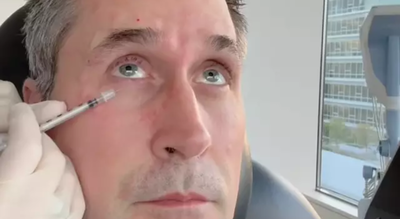
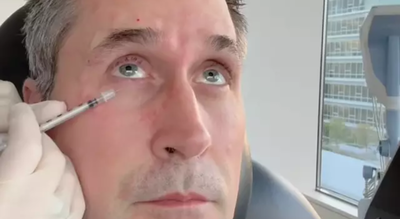
In an era when cosmetic treatments can feel abstract, over-marketed or shrouded in jargon, one Canadian dermatologist decided the best explanation was simple: show it. Dr Katie Beleznay, a board-certified dermatologist in both Canada and the United States, based in Vancouver and co-founder of Humphrey & Beleznay Cosmetic Dermatology, has built a substantial online following by breaking down cosmetic science in clear, accessible terms. But her latest demonstration went further than a diagram or tutorial, it involved injecting her own husband’s face with Botox, but only on one side. Her spouse, Ben, who she describes as both husband and “social media collaborator,” volunteered to be the split-face test case. The goal was straightforward: reveal, muscle by muscle, what neuromodulators like Botox actually do.
A demonstration, not a makeover
While Botox has been used for decades, both medically and cosmetically, many people considering it have only a vague sense of what it actually does, and plenty of cultural noise around it. It’s a treatment often associated with celebrity smoothness, influencer “tweakments,” and the occasional viral before-and-after that veers into the uncanny. For some, the word Botox evokes the polished foreheads of red-carpet regulars; for others, it’s linked to insecurity, overfilled faces, and the fear of winding up “botched.” Against that backdrop, Dr Beleznay often explains neuromodulators as “a natural and safe method of temporarily improving wrinkles and signs of ageing,” and on her clinic website she emphasises their effect: “Precise injections can temporarily relax targeted facial muscles, resulting in a smoother, more refreshed appearance.” But as she’s quick to acknowledge, some people “prefer to see the proof in the pudding.” So, on her YouTube channel last December, she filmed a detailed run-through of every point she would inject on Ben’s right side, leaving the left untreated for comparison. She narrated her plan clearly: treat the frown lines, forehead, crow’s feet, the “jelly roll” under the eye, the DAO muscle that pulls down the corner of the mouth, and the platysma in the neck, whose vertical bands can contribute to a harsher expression. Ben sat calmly as she worked through each syringe. Two weeks later, the couple returned to the camera to show the results, and the difference was unmistakable.
Two weeks later: A split-screen face
Dr Beleznay broke down the outcome point by point: “You can see him smiling with softening of the crow’s feet on the right hand side, and his eye looks a bit more open with treatment of the jelly roll.” She pointed out the change in his forehead as well: “When he’s lifting his brows, you can see the right side has fewer lines and is smoother compared to the left.” Even the areas not immediately associated with wrinkles showed contrast:“When he grimaces or does his mouth frown, you can see his left side pulls down more and he has a strong neckband, his right jawline is snatched up with less of a downturn mouth Corner.” One half of his face looked subtly refreshed, the other showed the natural creasing, pulling and muscle activation that Botox temporarily softens. The difference wasn’t cartoonish, but clinical and clear: exactly the effect she wanted viewers to understand.
Social media users loved the transparency and the side-by-side comparison. One viewer wrote, “I actually know very little about Botox, so this video was very eye-opening!” Dr Beleznay replied with a laugh: “Glad to hear it was helpful. Makes it worth it for my husband too!”
What botox is, and isn’t
Botox is often treated as a beauty buzzword, but medically it’s botulinum toxin type A, one of several neuromodulators used to temporarily block nerve signals to muscles. That’s why it smooths wrinkles: if a muscle can’t contract, the overlying skin doesn’t fold. Its effects fade gradually over three to four months, which is why upkeep matters. But it’s also highly precise — clinicians choose exactly which muscles to weaken, leaving surrounding ones fully active. The Cleveland Clinic describes Botox as a treatment used not just cosmetically but to “treat a wide range of other health conditions,” including migraines, muscle spasms and excessive sweating. Cosmetically, Botox can be used on:
- the forehead
- eyebrows
- crow’s feet
- nose lines
- lips
- chin
- jawline
- neck
Dr Beleznay’s demonstration covered many of these areas, showing how one treatment session affects expression patterns across the face.
Why the demonstration resonated
Cosmetic dermatology can seem mysterious if you’ve never had a treatment yourself. What made Dr Beleznay’s demo useful was its simplicity: people could see, on an ordinary face, how a neuromodulator changes movement on one side and leaves the other untouched.She wasn’t selling it as a miracle or suggesting everyone needs it. She was just showing, in straightforward terms, what Botox can and cannot do, and how targeted the results really are. Her website lists the benefits of neuromodulators in terms that mirror what viewers saw on Ben’s right side:
- smoothing wrinkles and fine lines
- enhancing symmetry
- non-invasive treatment with minimal downtime
- “a smoother, more refreshed appearance”
Leaving the other side untouched turned the demonstration into its own comparison chart, letting people judge the results for themselves, and judging by the comments, that was precisely what curious, hesitant or Botox-skeptical viewers wanted.