

US colleges confront a reading reckoning as professors warn of deepening Gen Z literacy gaps
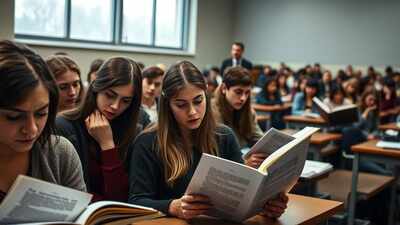
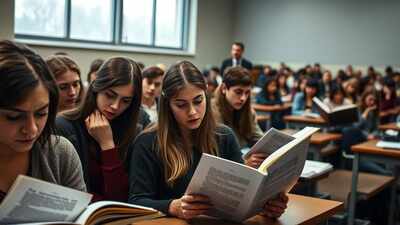
College classrooms across the US are confronting an uncomfortable question: What happens when students arrive at university unable to handle the reading expected of them?Professors say this is no longer an occasional concern. It is becoming routine. As first reported by The Mirror US, some faculty members argue that Gen Z’s reading abilities have weakened to the point that universities are being forced to rethink academic standards.
“It’s an inability to read sentences”
Jessica Hooten Wilson, a professor of great books and humanities at Pepperdine University, described what she is witnessing in blunt terms.“It’s not even an inability to critically think,” Wilson told Fortune, as cited by The Mirror US. “It’s an inability to read sentences.”Her concern goes beyond students skipping homework. She suggested that some undergraduates struggle to process the literal words on a page. To compensate, she often reads passages aloud in class, walking through them line by line.“I feel like I am tap dancing and having to read things aloud because there’s no way that anyone read it the night before,” she said. “Even when you read it in class with them, there’s so much they can’t process about the very words that are on the page.”For a professor who teaches classic texts, the shift has been stark.
Fewer books, shorter attention spans
The classroom experience reflects a broader national trend. According to YouGov data cited in the report, Americans aged 18 to 29 read an average of just 5.8 books in 2025. Nearly half of all Americans did not read a single book that year. Over the past decade, recreational reading has dropped by nearly 40%.The contrast is striking. Gen Z helped popularize “BookTok,” the TikTok community that drives book sales and literary trends. Yet enthusiasm online has not translated into consistent, sustained reading habits across the population.Scholars point to the dominance of smartphones and algorithm-driven content as possible factors. Social media rewards speed, skimming, and reaction. Literary texts demand patience, focus, and reflection, skills that develop only with practice.
Changing the way classes are taught
Wilson has responded by reshaping her courses. Rather than assigning long readings and assuming comprehension, she now integrates shared reading sessions during class, as reported by The Mirror US. Sometimes she spends an entire semester returning to a single poem or passage, helping students build interpretive depth gradually.The aim, she argues, is not to simplify content but to rebuild foundational skills. Close reading, she believes, is essential preparation for life after graduation, whether students enter law, business, education, or public service.
Not all professors see the situation as unprecedented
Timothy O’Malley, a theology professor at University of Notre Dame, said adapting to changing student behavior is simply part of the job. Earlier in his career, he assigned 25 to 40 pages of reading per class. Students either managed the workload or admitted difficulty.“Today, if you assign that amount of reading, they often don’t know what to do,” O’Malley said, as reported by The Mirror US.He added that many students now turn to AI-generated summaries rather than engaging directly with primary texts. While summaries provide surface-level information, they often miss tone, structure, and nuance, the very elements professors want students to notice.
A system that encouraged skimming?
O’Malley believes the roots of the problem stretch back to earlier schooling. Standardized testing, he argued, conditioned students to scan passages for specific answers instead of absorbing complex arguments. Reading became a strategy for passing exams rather than a habit of deep engagement. If that pattern continued through high school, colleges are now dealing with its consequences.Some faculty members insist that student unpreparedness has always existed. Others counter that the scale feels different. When students struggle with sentence-level comprehension, the challenge is not about motivation alone. It is about literacy.The debate now facing universities is delicate. Should institutions adjust expectations to reflect changing habits, or hold firm and risk widening the gap between standards and preparedness?For professors like Wilson, the concern is practical rather than ideological. Universities are meant to expand intellectual capacity. If students cannot engage deeply with text, the foundation of higher education itself begins to wobble.Whether this marks a temporary generational shift or a structural transformation in how young adults process information remains uncertain. What is clear is that many classrooms are already changing, one line, one paragraph, one carefully reread sentence at a time.