
CH-3 data reveals unexpectedly active electrical environment at Moon’s South Pole
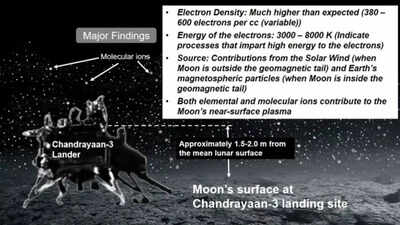
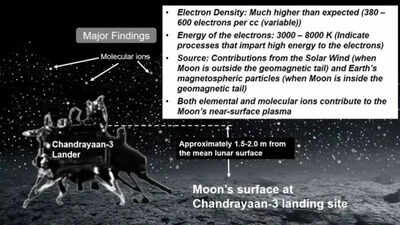
BENGALURU: Fresh analysis of data from the Chandrayaan-3 lander has revealed that the plasma environment near the Moon’s southern high latitudes is far more active than earlier believed. The results, based on measurements collected between Aug 23, 2023 and Sept 3, 2023, mark the first direct observations of near-surface plasma at such low altitudes in this region.Plasma, often described as the fourth state of matter, consists of charged particles such as ions and free electrons. Although it is electrically neutral overall, it responds keenly to electromagnetic forces. On the Moon, this thin plasma layer is shaped by several processes. “One is the solar wind, a constant flow of charged particles from the Sun that strikes the surface. Another is the photo-electric effect, in which high-energy sunlight knocks electrons off atoms in the regolith [soil] and the sparse atmosphere, leading to ionisation. The environment changes further when the Moon enters Earth’s magnetotail for a few days each month, allowing charged particles from Earth’s magnetic field to interact with the surface,” Isro said on Tuesday. The Radio Anatomy of the Moon Bound Hypersensitive ionosphere and Atmosphere – Langmuir Probe (RAMBHA-LP) on board the Vikram lander recorded electron densities between 380 and 600 electrons per cubic centimetre at Shiv Shakti Point (69.3° S, 32.3° E). “These values are notably higher than estimates inferred from radio occultation experiments conducted from orbit, which rely on changes in the phase of radio signals passing through the Moon’s thin atmosphere,” Isro said.The instrument also detected high-energy electrons, with kinetic temperatures between 3,000 and 8,000 Kelvin. According to mission scientists, this indicates an electrically active region shaped by continuous particle flows from both the Sun and Earth.“Data shows that the plasma is not steady but varies with the Moon’s orbital position. During lunar daytime, when the surface faces the Sun and lies outside Earth’s magnetic influence, changes in electron density are driven by solar wind particles colliding with the Moon’s exosphere. When the Moon moves into the geomagnetic tail, the influence shifts to charged particles flowing from Earth’s elongated magnetic field,” Isro added.Further insights came from the in-house Lunar Ionospheric Model, which suggests that molecular ions, possibly derived from gases such as carbon dioxide and water vapour, also play a role in building this charged near-surface layer.Isro scientists say the findings offer the ground truth needed for missions that aim to operate in the polar regions, where plasma behaviour affects communication systems, surface charging, dust movement and instrument performance. The RAMBHA-LP instrument was designed and developed by the Space Physics Laboratory at the Vikram Sarabhai Space Centre in Thiruvananthapuram.