

First humans reached Australia 60,000 years ago: How they arrived is finally clear |
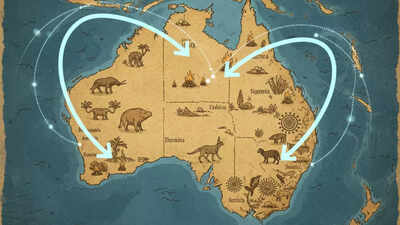
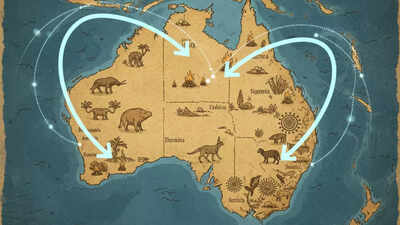
A major new genetic study has resolved one of archaeology’s longest-running debates, confirming that modern humans first reached Australia around 60,000 years ago. The findings align with archaeological discoveries and long-held Aboriginal oral histories that point to a deep human presence on the continent far earlier than some genetic models had previously suggested.Researchers analysed nearly 2,500 ancient and modern genomes from communities across Australia, New Guinea and the wider Pacific. The results, published in Science Advances, reveal not only when people arrived but also how they made the journey, uncovering two distinct migration routes into the ancient supercontinent known as Sahul.
Two pathways into ancient Australia
The study shows that the earliest ancestors of Aboriginal Australians and New Guineans reached Sahul via two separate routes. One group travelled south through the Indonesian islands toward northern Australia. Another moved through a northern corridor, likely passing through the Philippines before reaching New Guinea. These routes match oceanographic and archaeological models that have long suggested multiple viable entry points into Sahul.Both groups were part of a larger population that migrated out of Africa between 70,000 and 80,000 years ago. According to the researchers, the ancestors of Australians and New Guineans then split somewhere in South or Southeast Asia thousands of years before continuing eastward. The genetic data indicates that Aboriginal Australians and New Guineans carry some of the oldest continuous human lineages found anywhere outside Africa.
Migration shaped by oceans and climate
The findings confirm that early humans reached Sahul no earlier than 60,000 years ago and did so using watercraft, since the region was never fully connected to mainland Asia. Even at the lowest sea levels of the Pleistocene, significant ocean crossings were required. The study also suggests that migration into Near Oceania, including the Bismarck Archipelago and Solomon Islands, occurred around the same period, pointing to ongoing movement and interaction rather than isolated settlement.For decades, researchers have disagreed over whether Australia was settled 47,000 to 51,000 years ago or as early as 65,000 years ago. The new genetic timeline strongly supports the earlier date, offering one of the most precise reconstructions yet of when humans arrived and how they spread across Sahul. It also narrows the broader timeline for humanity’s dispersal from Africa, indicating a major migration event between 50,000 and 70,000 years ago.
A deep history confirmed
The results reinforce what many Aboriginal and Torres Strait Islander communities have always maintained: their connection to Country stretches back at least 60,000 years. Researchers say the findings not only strengthen the scientific timeline but also highlight the advanced seafaring knowledge required for these early journeys.Together with archaeological and climate evidence, this large-scale genetic analysis offers the clearest picture yet of one of humanity’s greatest migrations — the moment our species first reached the vast lands of ancient Australia.