
‘I chose self-respect over a degree’: An Indian student shares story of F-1 visa rejection over unclear intent


When students invest years preparing for an education abroad, only to have the final hurdle fall on the words of a visa officer, the sense of injustice can be profound. That is the experience of one Indian engineering graduate who secured an offer to pursue a Computer Science programme at a university ranked among the top 15 in the United States, only to be denied an F-1 student visa. His reaction: “I have spent enough time and resources chasing a fleeting dream… I have decided to keep working, prioritising my peace and self-respect over a degree.”Here is how his story unfolded, and what it reveals about the wider system.
From admit to denial
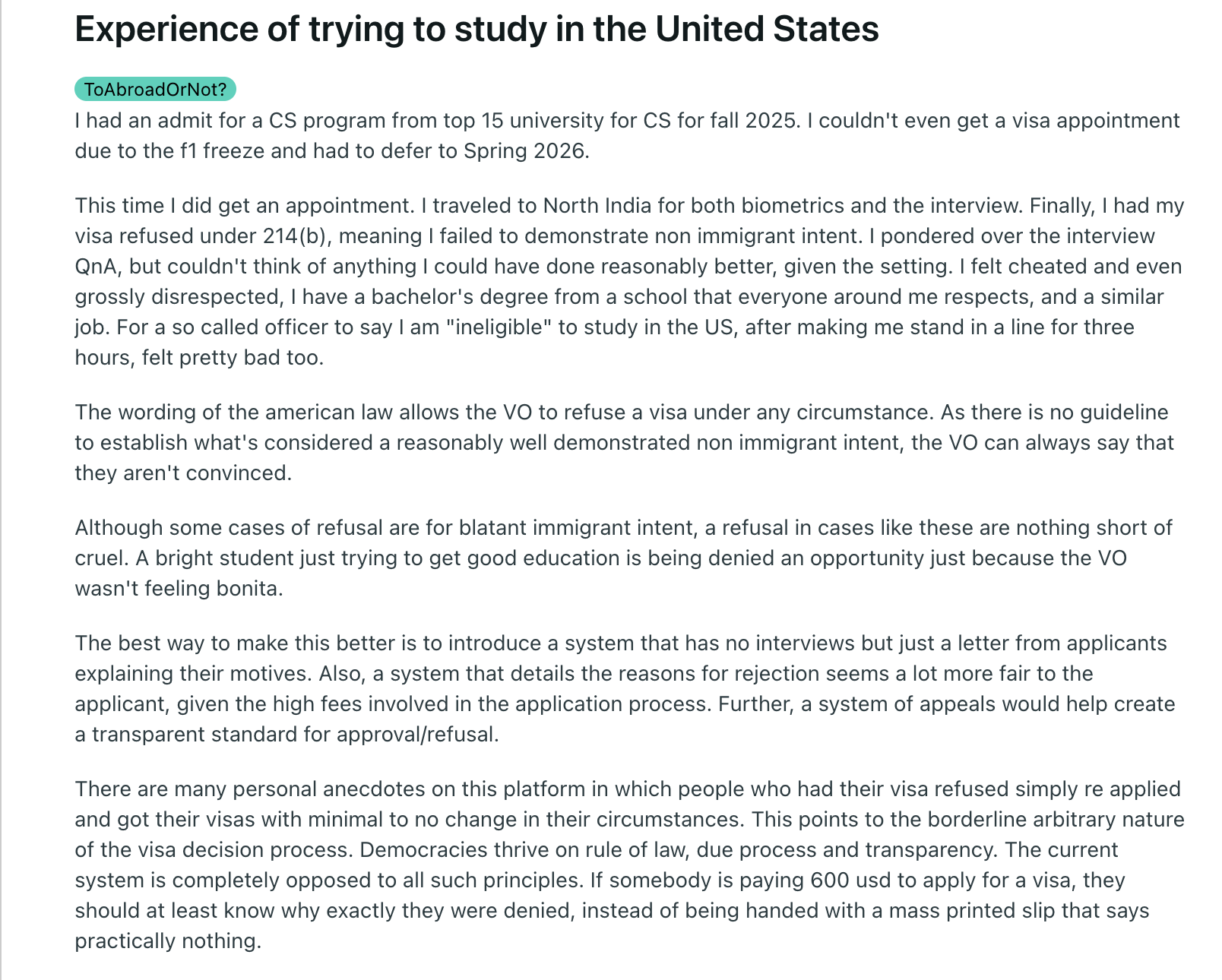
The student, with a strong academic record and two years of professional experience, received admission for the Fall 2025 intake at a leading university in the US, he wrote in a post on Reddit. Because of visa appointment delays caused by an F-1 processing freeze, he deferred to Spring 2026. When the time finally came, he travelled for biometrics and the interview. After waiting three hours in line, he received a refusal under the notation 214(b), a shorthand for denial under Section 214(b) of the Immigration and Nationality Act (INA). He was told his intent to leave the US at the end of his studies had not been satisfactorily established. He says: “For a so-called officer to say I am ‘ineligible’ to study in the US, after making me stand in a line for three hours, felt pretty bad.”He puzzled over the questions asked, noting that given his credentials and job, he could not think of anything he might reasonably have done differently. The key issue, as he sees it, lies less in his application and more in an opaque system that allows arbitrary judgment.
What is the F-1 visa and what does Section 214(b) mean?
The F-1 visa is a non-immigrant visa category for students coming to the US to pursue full-time academic studies at a certified institution. To qualify, an applicant must demonstrate enrolment, financial capacity, and the intention to return home after completing the programme.Section 214(b) of the Immigration and Nationality Act places the burden on the applicant to show they qualify for non-immigrant status. The law states: “Every alien shall be presumed to be an immigrant until he establishes to the satisfaction of the consular officer that he is entitled to non-immigrant status.” For students applying on an F-1 visa, it often translates into the requirement to satisfy the consular officer that their stay will be temporary, that they will abide by the student rules, and that they will return home thereafter.In practice a refusal under 214(b) means either:
- The officer is not convinced you will leave at the end of your authorised stay; or
- You have not met one or more of the specific visa requirements (funds, admission, etc.) that justify the classification.
Why do Indian students face 214(b) refusals?
Multiple students are vulnerable to denials under Section 214(b). Key reasons include:
- Weak ties to home country: Applicants need to show strong connections like employment, family, property, or other commitments that would prompt a return after studies. Without convincing evidence, the presumption of immigrant intent may prevail.
- Interview brevity and subjectivity: Some students report being asked only one or two questions and then given a refusal slip.
- Opaque criteria: The rules do not specify exactly what constitutes “strong enough” ties, leaving wide discretion to consular officers. This makes the decision feel arbitrary for the applicant.
- High scrutiny of Indian student applications: Because large numbers of Indian applicants apply for US study, consular officers may apply heightened caution, especially if the academic plan appears vague or the programme appears weakly linked to the home country’s professional context.
The applicant’s perspective
Even for a well-qualified candidate, the outcome may feel cruelly arbitrary. In his own words:“Although some cases of refusal are for blatant immigrant intent, a refusal in cases like these are nothing short of cruel. A bright student just trying to get a good education is being denied an opportunity just because the VO wasn’t feeling bonita.”He goes on to propose reforms: no interviews but a motive statement; transparent reasons for rejection; an appeals process. He points out that many anecdotal cases on forums show people re-applying and getting visas with minimal change, “this points to the borderline arbitrary nature of the visa decision process.”
The takeaway: What this refusal tells us
Students should prepare not just academically, but for how their story will be heard. It is helpful to clearly articulate your post-study plans, demonstrate ties to your home country, and ensure consistency in documents, funding statements, and interview responses.For counselors the focus should be on helping students express their non-immigrant intent sincerely: what the student plans to do after the degree, how it fits their home country context, and why return makes sense.For policy makers, the case highlights the lack of transparency and discretion built into the system. Students pay the visa fee, invest in university application fees and tests, yet receive a standard slip with no explanation. The process, critics argue, lacks elements of fairness, due process and rule-of-law.
A personal decision, and a broader question
Faced with the refusal and recognising the limited control over the outcome, the student decided:“I have a reasonably good job, a supporting family. With ever increasing xenophobia, lesser job opportunities and restrictions, I have decided to keep working, prioritising my peace and self-respect over a degree.”His choice underlines a deeper truth: for many, the “study-in-the-US” dream is no longer just about a foreign degree. It is about navigating a visa process that may pivot on a single question of intent, an intent no checklist fully addresses.For every student studying abroad, his story raises a question: When the gate is guided by discretion and not clarity, what does fairness look like?In reshaping your own path, remember: admission is only part of the journey. Although, understanding how the system works gives you better preparation — not guaranteed success, but stronger footing.