
NASA’s Chandra captures ‘young sun’ caught blowing bubbles in HD 61005’s astrosphere with moth-like dust wings |
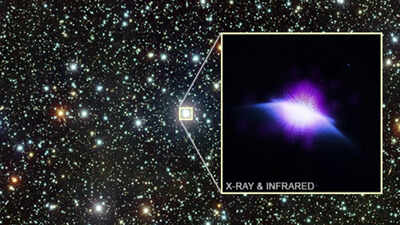
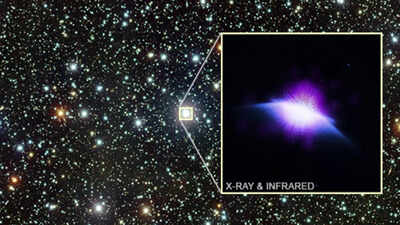
Astronomers have spotted something unusual. A star, much like our own Sun when it was young, is blowing a bubble through space. The star, called HD 61005, lies about 120 light-years from Earth. It seems ordinary at first glance. Same mass as the Sun, similar temperature. But it’s only around 100 million years old. That makes it a teenager in stellar terms. NASA’s Chandra X-ray Observatory captured the star’s “astrosphere,” a wind-blown bubble of hot gas expanding into cooler material. Experts say this gives a rare glimpse into what the early Sun’s environment might have looked like. And it’s not just a bubble. It has wings of dusty debris, giving it a “moth-like” shape.The discovery reportedly took decades of searching and precision imaging. Chandra’s X-ray vision, combined with infrared and optical data, allowed scientists to see the star and its surrounding bubble in unprecedented detail. Observers say it’s almost like watching a young Sun at play.
NASA reveals the massive astrosphere of HD 61005 and its dusty wings
The astrosphere around HD 61005 is massive. About 200 times the distance from Earth to the Sun. Winds from the star’s surface are three times faster and 25 times denser than those of our Sun today. They blow hot gas into the surrounding space, shaping the bubble. Scientists say it might even resemble the heliosphere, the bubble our Sun creates around itself.The dusty wings that trail the star make it look like a moth, which is why astronomers gave it the nickname. Infrared data show the material sweeping backwards as the star moves through space. It seems delicate but incredibly dynamic. This is a young star with personality, almost.
Researchers uncover the astrosphere of HD 61005 with Chandra’s X-ray imaging
Researchers have been hunting for astrospheres around Sun-like stars since the 1990s. Chandra’s high-resolution X-ray imaging finally made it possible. HD 61005’s proximity and its dense surrounding interstellar matter were key. The material around it is about a thousand times denser than near the Sun.The team, led by Casey Lisse at Johns Hopkins University, examined the star’s X-ray emissions. They could see where the stellar wind interacted with cooler gas and dust. It’s reportedly a spectacular view, with bright X-rays at the centre, wings of infrared light stretching outward, and the broader optical field showing the surrounding stars.
Inside HD 61005’s astrosphere
HD 61005 gives a glimpse into our Sun’s youth. Winds, debris, and the astrosphere all hints of what our solar system might have experienced billions of years ago. Scientists say this could help understand how planets and atmospheres formed. The star’s activity seems intense, yet there is a strange balance with the surrounding space.