
Trump threatens more tariffs on Indian rice! Why India has little to worry – and US consumers may bear the brunt
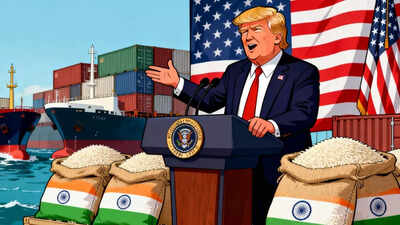
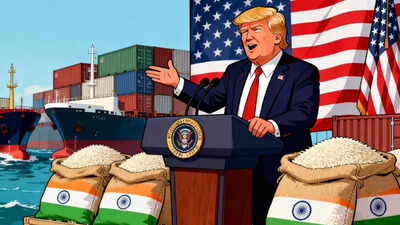
According to GTRI, Trump’s threat to impose new tariffs on Indian rice looks driven more by domestic politics than by trade logic. (AI image)
US President Donald Trump has warned that more tariffs could be imposed on Indian rice, saying that India should not be ‘dumping’ its rice into America. Trump said he will ‘take care’ of the situation’ and that tariffs can ‘easily resolve the problem’. The Trump administration has already imposed a 50% tariff on Indian goods being exported to the US, one of the highest tariff rates faced by any country in the world by America.Trump’s comments came during a White House roundtable discussion convened with farming sector representatives and cabinet officials, including Treasury Secretary Scott Bessent and Agriculture Secretary Brooke Rollins, where Trump declared a $12 billion federal aid package for farmers.
Trump’s latest warning on tariffs on Indian rice
Trump asked Bessent about India’s trade practices, specifically questioning, “India, tell me about India. Why is India allowed to do that? They have to pay tariffs. Do they have an exemption on rice?” The response confirmed “No sir, we’re still working on their trade deal”.Trump replied: “But they shouldn’t be dumping. I mean, I heard that. I heard that from others. They can’t do that.” This led to discussion about an ongoing World Trade Organisation case against India.
Trump tariffs on rice: What does it mean for India?
According to Ajay Srivastava, founder of Global Trade Research Initiative (GTRI), Trump’s threat to impose new tariffs on Indian rice looks driven more by domestic politics than by trade logic.“India exported $392 million worth of rice to the US in FY2025, just 3% of its global rice exports, and already faces tariffs of about 53% in the US market; 86% of these shipments are premium basmati,” points out GTRI.New duties would scarcely dent Indian exporters, who have strong markets elsewhere, but would make rice costlier for American households, says GTRI. Trump, in the same event, also threatened high tariffs on Agriculture imports from Canada and other countries.“India should read this as election-season messaging to US farmers—not a serious policy shift—and avoid offering concessions to a threat that hurts US consumers more than Indian producers,” GTRI says.Meanwhile, the Indian Rice Exporters Federation (IREF) has issued a factual clarification regarding Indo-US rice trade dynamics, following the US President’s recent comments about Indian rice.“The Indian rice export industry is resilient and globally competitive,” said Dev Garg, Vice President, Indian Rice Exporters Federation. “While the US is an important destination, India’s rice exports are well-diversified across global markets. The Federation, in close coordination with the Government of India, continues to deepen existing trade partnerships and open new markets for Indian rice.”“During the financial year 2024–2025, India exported Basmati rice worth $337.10 million to the United States, amounting to 274,213.14 metric tonnes (MT). This places the US as the 4th largest market for Indian Basmati rice. In the same period, India exported non-Basmati rice valued at $54.64 million, totalling 61,341.54 MT, making the US the 24th largest market for Indian non-Basmati rice,” says IREF.The consumption pattern in the US indicates that Indian rice is primarily purchased by Gulf and subcontinent ethnic populations. The demand shows consistent growth, particularly driven by the increasing popularity of Indian cuisine, especially dishes like biryani, where Basmati rice serves as a crucial, irreplaceable component, IREF said.Indian rice exports to the United States continue to be influenced by direct consumer demand, with exporters fulfilling pre-arranged orders from US importers. “Importantly, rice grown in the US is not a like-for-like substitute for Indian rice. Indian Basmati has a distinct aroma, elongation, texture, and flavour profile, and US-grown varieties generally do not meet the requirements of traditional dishes from the Gulf and South Asian regions,” IREF said.Before the latest duty revision, Indian rice imports were subject to a 10% tariff in the American market. The recent increase has elevated this to 50%. Nevertheless, exports have persisted, demonstrating the product’s fundamental importance to consumers. Market observations show that American consumers are bearing the majority of the increased tariff costs through higher retail prices, whilst Indian producers and exporters maintain their previous revenue levels.“Evidence from retail markets indicates that most of the tariff burden has been passed on to US consumers, as reflected in higher retail pack prices, while export realizations for Indian farmers and exporters have remained broadly stable,” IREF said.