
Why Australia is spreading sheep’s wool on barren land to save soil |
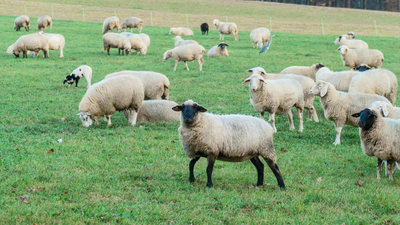
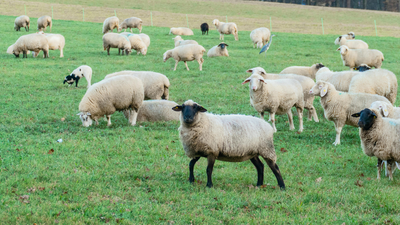
Across large parts of rural Australia, farmers are facing harsher conditions. Rainfall is less reliable. Soils are losing structure. Fields that once supported crops are increasingly turning to dust. Years of drought and intensive farming have stripped soil of organic matter, making it harder for land to absorb and retain water. For many growers, the priority is no longer higher yields but keeping land productive at all.At the same time, sheep farmers are dealing with a separate challenge. Large volumes of coarse, low-grade wool are piling up in shearing sheds. Much of it has little value in global textile markets and often costs more to store or dispose of than it earns. What was once treated as waste is now being reconsidered. By spreading sheep’s wool on drought-hit fields, farmers and researchers are testing a simple approach that is showing measurable gains in soil health.
Sheep’s wool finds a new role as soil cover
In sheep-grazing regions such as New South Wales, significant amounts of wool cannot be sold at a profit. The fibres are often too coarse or short for clothing or carpets. Rather than discarding it, farmers are using the material as mulch or soil amendment.Industry body Australian Wool Innovation has supported research into new uses for surplus wool. Soil applications are one area of focus, especially where land resilience and waste reduction overlap.When spread across bare soil or mixed into the surface layer, wool forms a protective cover. It reduces exposure to sun and wind, two major drivers of moisture loss in dry landscapes.
How wool helps soil retain water
Wool fibres can absorb up to twice their weight in water. They release that moisture slowly over time. Soil scientists say this property helps keep water available near plant roots for longer periods.Field trials across several seasons show that wool-treated soil loses less moisture to evaporation than untreated ground. In many cases, moisture levels remain higher for longer than with conventional organic mulches.Researchers at CSIRO note that improving water retention is critical for drought resilience. Organic amendments that hold moisture and rebuild structure are especially valuable in degraded soils.
Rebuilding life in degraded soil
Water retention is only part of the effect. Wool also supports biological recovery. Healthy soil depends on microorganisms that cycle nutrients and bind soil particles together. In degraded land, these organisms are often scarce.Soil samples from wool-treated plots show clear increases in microbial activity within months. Agronomists say this signals a return of soil function. As microbial life recovers, soil structure improves. Erosion declines. Roots penetrate more easily.In some trial areas, researchers recorded visible changes after a single dry season. Soil that once blew away in the wind began to hold together again.
A slow-release source of nutrients
Wool contains nitrogen, sulphur and carbon. These elements are essential for plant growth. They are locked inside keratin, a protein that breaks down slowly.Studies show this slow decomposition releases nutrients gradually. This reduces leaching and runoff, problems often linked to synthetic fertilisers. Researchers have found wool-based amendments can perform similarly to organic fertilisers in some crops while offering longer-term soil benefits.
Processing wool for the field
Raw wool cannot be used everywhere without preparation. Unprocessed fibres can clump and restrict water movement if applied incorrectly.To avoid this, wool is increasingly processed into pellets, granules or blended products. These forms are easier to spread and mix evenly into soil. Some are combined with organic matter or beneficial microbes to improve consistency and performance.Experts stress that results depend on soil type, climate and application rate. Wool works best as part of a broader soil management strategy.
Economic and environmental benefits
Using waste wool in agriculture offers economic gains. It creates new markets for a low-value product and supports rural processing jobs. Processed wool products can be worth several times more than raw surplus wool.The environmental benefits are also clear. Wool reduces reliance on energy-intensive synthetic inputs and supports circular farming practices. Agricultural economists say these dual benefits are increasingly important as farmers face rising costs and climate pressure.
Interest beyond Australia
The approach is attracting attention overseas. European researchers are testing wool-based soil treatments using coarse fibres from meat and dairy sheep. Early results from trials in Poland, Italy and Germany show improved moisture retention and stronger crop growth.Scientists involved say Australia’s work provides useful data for wider adoption. For Australian farmers facing longer droughts and declining soil quality, wool offers a practical tool backed by research. By turning an overlooked by-product into a soil amendment, farmers are restoring land once thought to be beyond recovery.